Last week’s IFPE show, held in conjunction with the CONEXPO/CON-AGG events in Las Vegas, was by almost any measure a blockbuster. 120,000 registered attendees from 150 countries saw 2400 exhibitors that took up 2.34 million sq-ft of exhibit space. IFPE itself was the largest show in history, and there was a distinctly international feel to the whole event. Fully 24% of registrations were international, also a record.
A good deal of the companies exhibiting did not have revolutionary—much less particularly new—offerings. But if there was one recurring theme I heard all week, it wasn’t really a single product or technology—it was the supply chain. During the recession, a lot of manufacturers and distributors sold out of their inventory, taking levels down to an uncomfortable level. Now that machine production is ramping up, many of the component manufacturers are finding themselves having difficultly meeting customer demands along with re-filling that distribution pipeline.
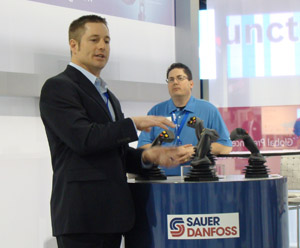
Jesse Barthel of Sauer-Danfoss (above) explained that in this post-recession time, everyone is trying to make their supply chain nimble yet responsive. In the boom days, just-in-time delivery was the mantra, but that’s not really possible now.
“Companies are trying to keep inventories low yet not lose any orders due to lead times,” said Barthel. “The new game in the supply chain is ‘trying to push the pain back to someone else.’”
I found little evidence that customers were demanding new products, but they are concerned with lead times. Manufacturers are having some problems with materials, and steel shortages are certainly an issue. For some, rare earth metals are another problem. China, which controls more than 80% of that market, seems to be manipulating it under the guise of environmentalism, according to some I spoke with. How that will turn out in the coming year is anyone’s guess, but any products that incorporate magnets will likely be affected to an increasing degree.
There is certainly movement toward green products, and a lot of that is being pushed by Tier 4 requirements, certainly a positive trend. Much of the development continues to be on the electronic controls side of the components, toward making the whole machine run more efficient.
And efficiency was being touted everywhere. From Rexroth’s Blue Hydraulics program to Parker Hannifin’s RunWise hybrid product to Eaton’s LifeSense hose monitoring, everyone was talking about doing more with less.
In the end, exhibitors were thrilled with the floor traffic, and attendees seemed to simply be happy that the long-awaited upswing is finally upon us.
